
Perry Former Owners by Transfer
A deed chain runs in sequence, not as one list returned by an address search. The Perry PVA card supplies the present deed reference. Start there. In the County Clerk index, the newest grantee points to the party who conveyed the land. That grantor then becomes the grantee in the next older search. Each step must match the same tract. Legal descriptions, book and page links, plats, and adjoining owners hold the sequence together as it moves back through the Perry County deed records.
| Source | Years It Covers | Where Held | What It Shows |
|---|---|---|---|
| eCCLIX index | Documented to 1993 | Online or Clerk terminal | Party, type, date, reference |
| Online images | As far back as 2000 | eCCLIX by access level | Recorded instrument image |
| Permanent deed books | Older county holdings | Perry Clerk counter and vault | Earlier conveyances and indexes |
| Catalogs and microfilm | 1818 onward in listed runs | FamilySearch and KDLA | Volume clues and older chain |
The Perry Online Land Records page routes current searching to eCCLIX. It also describes a much older body of legal records. Online index depth is not the same as county custody. Begin with the newest link. When dates push past what the index reaches, shift to the counter, deed books, and archives.
The eCCLIX login and search entry is the online doorway. It covers the recent Perry deed chain. Use it first. Keep both tools in mind.
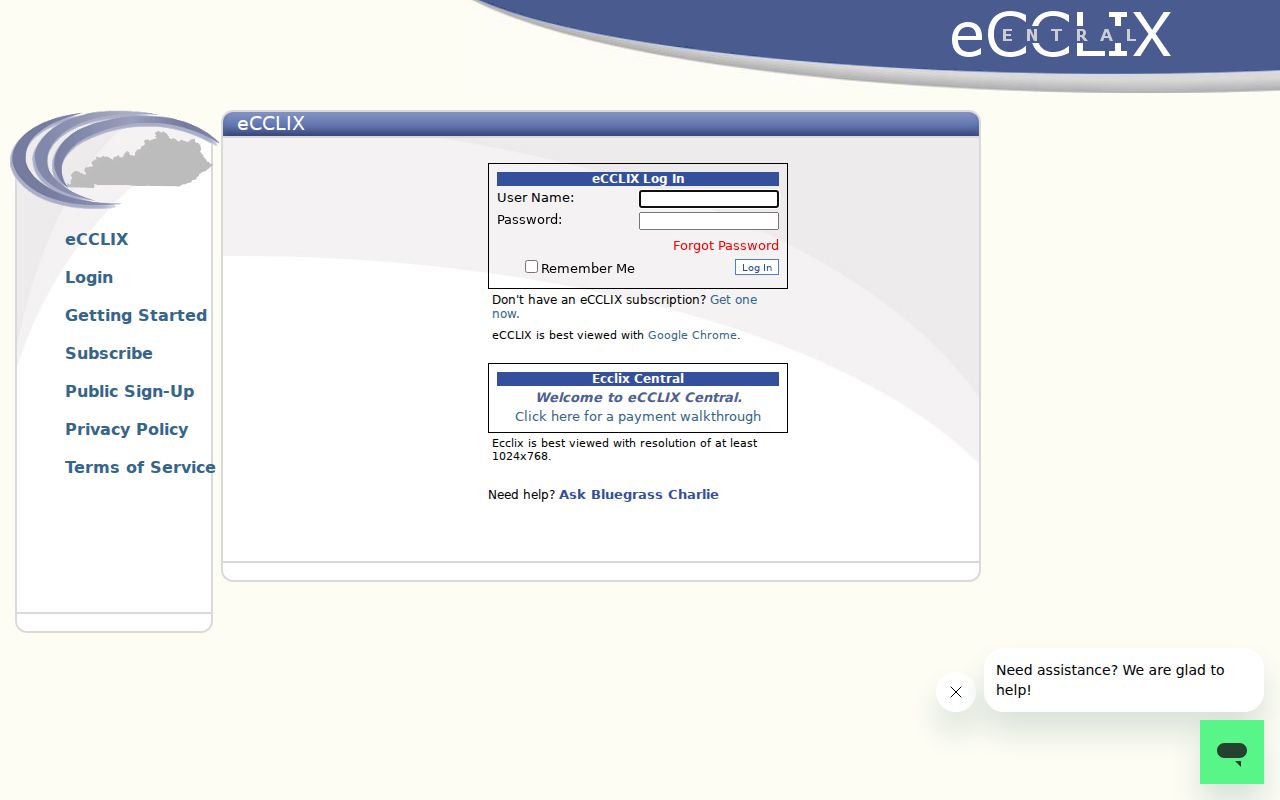
The eCCLIX sign-in screen displays the correct service for Perry land records. Account access still governs what opens. County record availability controls which index entries and images can be viewed.
Perry's 1993 Index Boundary
The Clerk FAQ documents an online index reaching through 1993. It also documents images as far back as 2000. Keep those dates distinct. An index entry can name a prior owner. It can give a book/page even when no image is online. Check eCCLIX "What's Available" first. Then ask the Clerk for the volume if the image is missing.
Online cutoff. The index reaches 1993 and images reach about 2000; older Perry owners require books, microfilm, or archival access.
Official eCCLIX support says data reloads overnight, and verified images may post the next day. That delay touches new deeds only. Historic coverage stays put. Note the search date whenever a recent result or missing image matters.
Perry Deed Books and Archives
The FamilySearch catalog lists Perry deed records for 1818 through 1901 and a general index reaching 1818 through 1913. A second catalog covers Perry land records from 1821 through 1964. Both are finding aids. Images may need a login. Some open only at a FamilySearch center.
The Kentucky Department for Libraries and Archives holds original and microfilm county material. Its Frankfort research room runs Monday through Thursday, 9 a.m. to 3:30 p.m. Appointments are encouraged. Closer to home, the Perry County Public Library offers newspapers, cemetery, census, marriage, death, family-history, and microfilm resources. Library clues identify people and places. Deeds still prove the transfers.
Note: Carry a volume, page, surname, date, and land description into an archive request; a street address alone may fail.
Perry Land Before 1821
Perry County formed in 1821 from Floyd and Clay counties. The land never moved. Yet a long former-owner chain can cross that jurisdiction line. Old descriptions hold the answer. Creek, ridge, adjoining-owner, survey, and grant clues from the oldest confirmed deed point the way. They show which predecessor records to check. The catalog's 1818 start does not erase county formation. Ask the Clerk or KDLA how the early material was grouped, and document the answer. Mark uncertainty instead of forcing an unsupported Perry owner into the gap.
Reconstruct Perry Ownership Backward
The eCCLIX entry searches party names, document type, book/page, instrument number, and recording dates, within county coverage. It has no address or tax-lot search. Convert an address through PVA/qPublic first. Then trace Perry County previous owners through the deed chain.
- Find the newest deed and copy its grantee, grantor, type, date, and exact reference.
- Search that grantor as an earlier grantee. Try initials, punctuation, LLC, trust, estate, and married-name variants.
- Match the legal description and prior-deed citation. Reject same-name hits tied to different land.
- Repeat to the cutoff, then take the last sound reference to deed books, microfilm, or archives.
- Grantor
- The party conveying an interest away.
- Grantee
- The party receiving the stated interest.
- Chain of title
- The linked sequence of recorded transfers for the same land.
- Reverse index
- An index arranged by grantor, useful for following conveyances backward.
- Legal description
- Recorded land language that is more stable than an old street address.
Perry Estate and Court Deeds
A clean buyer-to-seller sequence can break. Owners die, and courts order sales. Search affidavits of descent, wills, executor or administrator deeds, commissioner deeds, sheriff's deeds, powers of attorney, lis pendens, and judgments. The County Clerk records the land instrument itself. The Perry court file supplies the appointment, authority, orders, and pleadings behind it.
A death or marriage record may identify a person. Neither conveys land by itself. Copy both the court reference and the recorded deed whenever an heir, estate, or commissioner enters the chain. Those linked records explain why prior owners changed without an ordinary sale.
Former Owners Near Bowlingtown
Buckhorn's official history says lake construction between 1956 and 1960 displaced Bowlingtown, its homes, and its cemeteries. Names shifted too. Older Perry County former owners near the lake may appear under Bowlingtown, Route 28, a family tract, or land language that no longer matches today's shore and roads. Search that former place name in library and archive material. Then return to deeds and plats for proof. The lake story gives geography, not a boundary. A sound chain records when names and landmarks changed.
Perry Name Variants in Old Records
Old Perry County records rarely show a name the same way twice. A prior owner may appear under initials. She may appear under a married surname, a misspelling, an estate label, a trust, or a business suffix. Search both sides of each deed. Check grantor and grantee roles, then widen the date span. For an LLC, run the name with and without punctuation. When an instrument names an executor, administrator, or heir, search the decedent too. Search each of those parties as well.
A matching name settles nothing by itself. Confirm the legal description, tract size, and the plat. Check any creek or road named, neighboring owners, and the earlier deed a document cites. The PVA mailing line can help separate same-name parties. A mailing address never proves someone lived on the parcel, though. Log every rejected hit. That keeps a false match from masquerading as a missing link later in your property records work.
Perry Former Owner Requests
The Perry County Clerk's Records Center sits at 481 Main Street, Suite 102, in Hazard. Hours run Monday through Friday, 8 a.m. to 4 p.m. A public-use computer there mirrors the basic eCCLIX search available on the web system. Counter access matters most when a book, image, or index entry never made it online.
Mail and written open-records requests give you a second path. State the exact party, deed type, date span, and volume and page. Also say how you want delivery. Kentucky's usual response target is five business days, subject to a written extension and exemptions. The current Records Center page lists mailed real-estate copies at 25 cents per page. It adds $2 postage and handling per request. An older policy shows a different per-page amount. Confirm the live charge before you order any deed records.
Perry County Chain Research Log
A good chain log earns its keep. For each step, record the source, search date, party role, document type, recording date, book and page or instrument number, and the land clue that clinched the match. Log failed searches and rejected same-name results as well. That way a Perry County former-owner conclusion shows exactly where its evidence stops.
Never smooth over a missing link. Label the gap's cause: online cutoff, missing image, unverified name variant, probate event, or predecessor-county geography. Then point the next search where the evidence demands. The Clerk, the Perry court clerk, KDLA, FamilySearch, or the local library each fill a different hole in the property records chain.
How Far Perry Owners Go Back
Perry County's own history starts in 1821. The Clerk, though, describes some legal records reaching back to the late 1700s. The honest answer is layered. Recent former owners show up in the online-era index. Earlier Perry transfers survive in permanent books and archival copies. Pre-formation research may shift to Floyd or Clay County records. Exact depth depends on the instrument and volume.
Lawful use. Trace Perry County former owners for house history, title research, estates, or property diligence, never to track or harass a living person.
The Clerk counter welcomes visitors weekdays, 8 a.m. to 4 p.m. A written Kentucky Open Records Act request can seek any named record. Describe the volume, page, party, date range, and type. Need a single recorded copy? Use the Perry County deed record route. Finish by logging sources, spelling variants, failed searches, and gaps so the whole chain stays reproducible.