
Perry County Tax Record Fields
Perry County property tax records are a linked set rather than a single screen. The Perry County Property Valuation Administrator creates the assessment roll, lists the tax-roll owner, and records parcel characteristics and exemptions. The PVA values all taxable real property each year at 100 percent of fair cash value as of January 1. It does not set tax rates and does not collect the bill. Current collections belong to the Perry County Sheriff, while unpaid bills that transfer after the collection period become County Clerk records.
| Tax field | Meaning in the record | Custodian |
|---|---|---|
| Owner, mailing, location | Separate roll fields tying a taxpayer and situs to a parcel | Perry County PVA |
| Assessed value | Fair cash value fixed for the January 1 assessment date | Perry County PVA |
| Class and tax district | Assessment class and district used with applicable rates | Perry County PVA |
| Current bill | Amount due and status during the current collection cycle | Perry County Sheriff |
| Delinquent bill | Bill number, year/type, owner, address, map ID, and amount due | County Clerk and DTAX |
An assessed figure is not a sale price. Kentucky's fair cash value standard imagines a willing voluntary sale, while the final property tax blends the assessment with state, county, city, school, and special-district rates. A recorded deed can state consideration. A bill cannot. For help sorting those numbers apart, see the separate Perry County property value guide.
Perry County's January Tax Snapshot
January 1 anchors all Perry County property tax research. The PVA assesses taxable real estate annually as of that date. Staff may lean on field inspections and electrical-inspector permits. State mobile-home transfer lists and park lists help too. Measurements and photographs round out the review. That is why the roll can shift with no new deed in sight.
A four-year cycle governs countywide valuation review, though an area may see inspectors sooner. The cycle promises nothing about how fast a sale posts. Note: Keep every copied figure paired with the card's effective date and the tax year.
Note: A four-year countywide review does not turn a dated assessment card into a current appraisal or boundary record.
Trace a Perry County Tax Bill
Perry County offers no interactive portal for checking a current tax bill online. Work the channels that exist instead. Begin with the free basic PVA/qPublic search, which the PVA describes as a source of ownership and assessed value. Copy the parcel number, owner field, tax district, and situs exactly as displayed. Then ask the Perry County Sheriff at 120 N Hamilton Street in Hazard, phone (606) 439-4523, about the current collection status of the bill.
- Find the parcel card by address, owner, or parcel number in PVA/qPublic.
- Record the assessment year, value, tax district, owner, and parcel key.
- Ask the Sheriff for the current bill and payment status using those identifiers.
- If unpaid taxes transferred, check the County Clerk delinquent list and recorded lien trail.
- Assessed value
- The PVA's taxable real-property valuation under the fair-cash-value standard.
- Levy or tax rate
- The rate applied by the relevant taxing bodies, which the PVA does not set.
- Homestead exemption
- Qualified relief applied through the PVA after the required form and proof.
- Tax lien
- A recorded claim tied to unpaid taxes, distinct from the ordinary current bill.
Perry County Tax Roll Lag
Buy after January 1 and the prior owner may linger on the property tax bill until the next year. The PVA notes that timing can leave the seller named, show a “c/o” entry, or show no name at all. Treat that as a clue. Never force it into an ownership conclusion.
When a closing is fresh, compare the roll against the latest recorded deed. The deed's recording date and grantee prove the transfer far better than a bill built on the January snapshot. Keep both dates in your notes. The apparent mismatch then explains itself.
Timing matters. A tax-roll name can trail a recent closing; the newest recorded deed is the better evidence of that transfer.
Perry County Tax Exemption Forms
The PVA forms page is the local starting point for exemption and property-status paperwork. Downloads include form 60A350 for homestead or disability relief, a mailing-address change, form 62A023 for exemption applications, form 62A351 for agricultural or horticultural use, and form 62A378 for mobile homes. Eligibility and proof vary by form. A label on a tax card alone proves nothing for a new owner.
Put the parcel number on the application. Ask the PVA which supporting documents fit the claimed relief. If an exemption seems absent from Perry County property tax records, weigh the application date against the tax year before assuming an error. The PVA office sits at 481 Main Street, Suite 201, Hazard, and is open Monday through Friday from 8 a.m. to 4 p.m.
Reading Perry County DTAX Records
Delinquent Perry County property tax records travel a different channel. The Sheriff collects current bills until April 15 of the following year. Unpaid accounts then move to the County Clerk. The tax sale follows before the end of August after notice in the local paper and on the Clerk website. Registered third-party purchasers can buy certificates. Those certificates create liens recorded against the property.
The Kentucky DTAX entry is linked by the Clerk. It opens the online route to the Perry list. It is a posted list or PDF rather than a live current-bill search. The official page shows the entry point, not a parcel result.
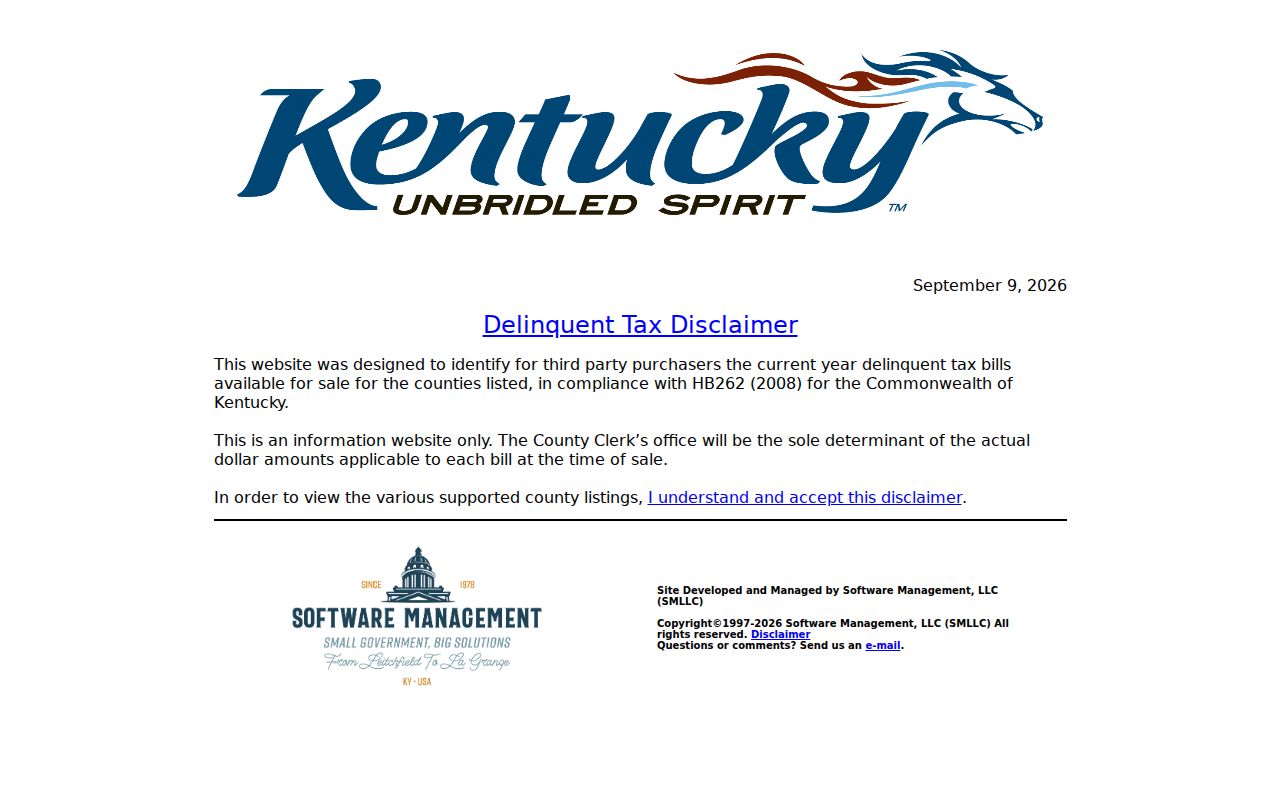
Columns on the list are Bill Number, Year/Type, Owner Name, Property Address, Map ID, and Amount Due. Copy the year and map ID along with the amount. A name alone may match several accounts. Older years may call for the Clerk or Software Management rather than a portal filter.
Kentucky Calendar for Perry Taxes
Kentucky sets the calendar, and Perry County follows it. Under the state collection schedule, bills reach the Sheriff by September 15. Pay early and save. A two-percent discount runs through November 1. Face amount applies from November 2 through December 31, then a five-percent penalty lands during January. After January 31 the bill picks up a ten-percent penalty plus the Sheriff add-on. Everything transfers to the County Clerk on April 15.
For a certificate sale, trust the local notice. The statewide window of July 14 through August 28 is only a framework, and Perry County's posted sale notice sets the actual date, a distinction that matters when a parcel carries a delinquent entry or a recorded tax lien.
Contest a Perry County Assessment
Every Perry County assessment challenge starts at the PVA. An owner must confer with the office during the statutory inspection period. Nothing else can move forward before that. The Perry County appeals page lays out that first step. Evidence can be almost anything that bears on fair cash value. Think comparable sales, an independent appraisal, photographs, or construction details. Bring the parcel number and the assessment notice. Also bring your documentation in a form the office can review.
A failed conference sends the dispute to the local board. The appeal form comes from the County Clerk. It must be in hand within one working day after the inspection period closes. No fixed calendar date applies every year. Confirm the current inspection window with the PVA instead of relying on an old deadline.
Protect the appeal window. Confer with the PVA before inspection closes, then obtain the board form from the Clerk by the next working day.
Request Missing Perry Tax Records
Sometimes the online card or DTAX list falls short. Then use the counter, phone, mail, or a written request. Each office owns a different slice of the record. The PVA explains assessment records. The Sheriff handles current collection status. The County Clerk, at 481 Main Street, Suite 102 in Hazard, holds transferred delinquent accounts, certificate records, and recorded liens. Clerk deed and recording rooms are open weekdays from 8 a.m. to 4 p.m.
Written requests follow the Kentucky Open Records Act, KRS 61.870 through 61.884. The Clerk's open-records route spells out the procedure. Identify the parcel or bill, the record type, the date range, your contact information, and how you want delivery. Kentucky agencies generally answer within five business days or explain the delay in writing.
Reconcile Perry County Tax Sources
A thorough tax check deserves a dated source log. Start with the PVA card. Note its assessment year, the January 1 context, parcel number, owner, and location address. Add the tax district and exemption flags. Add the Sheriff's current-bill response or receipt details. Do that only if the active collection cycle is the question. For a transferred account, copy the DTAX bill number, year and type, map ID, and amount due. Also note the date shown on the posted list.
These identifiers head off two common mistakes. Similar owner names can attach to more than one parcel. A current assessment and an older delinquent bill can both be valid. Each describes a different stage of the tax trail. The Clerk's recorded certificate or lien adds yet another date and document reference. Keep it separate from the original tax bill.
When figures conflict, ask the custodian of that field. The PVA explains valuation and exemptions. The Sheriff explains current collection. The Clerk explains transferred delinquency and recorded instruments. Route each question to the office that owns the answer. Preserve the answer, the office, the access date, and any stated effective date. That discipline turns Perry County property tax records into a clear timeline. It ends the guessing game about which system refreshed first.