
Starting a Perry County Property Search
Where you start depends on what you know. The PVA roll on qPublic handles basic ownership and assessment questions. Recorded documents are another matter, since eCCLIX searches them by parties and references rather than by street address, tax lot, or bill number. An address must first be translated into an owner, a parcel number, and a legal description.
Record each result before moving on. Names vary with initials, suffixes, trusts, and estates. Street labels change too. The parcel number is the strongest link inside the PVA and map system, but the legal description serves as the better bridge to the deed.
- Enter the location in the Perry qPublic search and try a shorter road name if the full address fails.
- Open the parcel card and save its APN, account, Owner, Mailing, Location Address, and description.
- Search the exact owner in eCCLIX, then try name variants and the other party to the transfer.
- Match the deed by legal description, record date, document type, and book/page reference.
- Check the View Map link and the proper tax source, then request the image or certified copy needed.
Perry County Address Search Route
Address searching belongs at the PVA, not the deed index. Enter the number and core road name first. If nothing comes back, drop a directional or suffix and scan the likely matches. Hazard-area postal labels, community names like Chavies, and road-name variants can all shift a result. Out-of-area mailing addresses can shift a result too.
Once the card opens, copy the returned location exactly. Do not correct a ZIP or turn a community name into a city name. The PVA record bridges you to the owner. It also carries the legal text you will need later. Keep the mechanics on finding and matching the parcel. Deed interpretation belongs with the land record itself.
Note: A postal city or ZIP can help locate a parcel. It proves nothing about municipal boundaries.
Perry County Owner Search Variants
An owner search pulls every parcel filed under one spelling. For a person, search last name first and keep any initials. For an entity, try the full legal name. Then strip punctuation and test common forms like LLC, estate, heirs, trustee, or trust. Similar names alone cannot justify merging results.
Read the PVA Owner field separately from Mailing. A mailing line may name a contact, manager, or care-of party instead. It also says nothing about who occupies the property. Once the tract is identified, test the match against the newest deed's grantee and legal description. The grantee is the party receiving the interest.
| Search field | Input | Useful result | Limit |
|---|---|---|---|
| Address | Number and road | Parcel card | Road variants |
| Owner | Person or entity | Matched parcels | Name variants |
| Parcel/APN | Exact identifier | Specific card | Suffix matters |
Perry County Parcel Number Pattern
Perry parcels use formatted identifiers such as 034-20-01-002.00. Keep every dash, digit, and suffix. The same sample card lists account 696509, which is a different key altogether. An account number should never stand in for the APN. Request a map or plat with the parcel number instead.
The APN links the tax card to the parcel view. It does not replace a deed citation. Record both the parcel identifier and the legal description. Subdivisions, splits, consolidations, and historic tract language can change how the land is indexed.
- APN or parcel number
- The PVA identifier for a mapped tax parcel.
- Account number
- A separate administrative number on the assessment card.
- Situs address
- The location address of the real estate.
- Owner of record
- The owner named on the current assessment roll, which may lag a deed.
Perry County eCCLIX Name Fields
The Clerk's Online Land Records page leads to eCCLIX. Its documented route searches by county, grantor or grantee, document type, book and page, instrument reference where present, and a recording date range. A grantor conveys; a grantee receives.
| Index key | How it helps | Check against |
|---|---|---|
| Grantor | Finds the transferring party | Prior deed and description |
| Grantee | Finds the receiving party | PVA Owner field |
| Document type | Narrows deed, mortgage, lien, or release | Research goal |
| Book/Page | Retrieves a known record | Later deed citation |
| Date range | Limits broad name hits | Sale or filing date |
The system reloads its data overnight. Images can lag behind indexing, so check the next day for a newly filed document. Internet access may require an account or paid subscription. The Clerk's public-use computer offers the same basic search. The Clerk's land-record access page displays the official entry point.
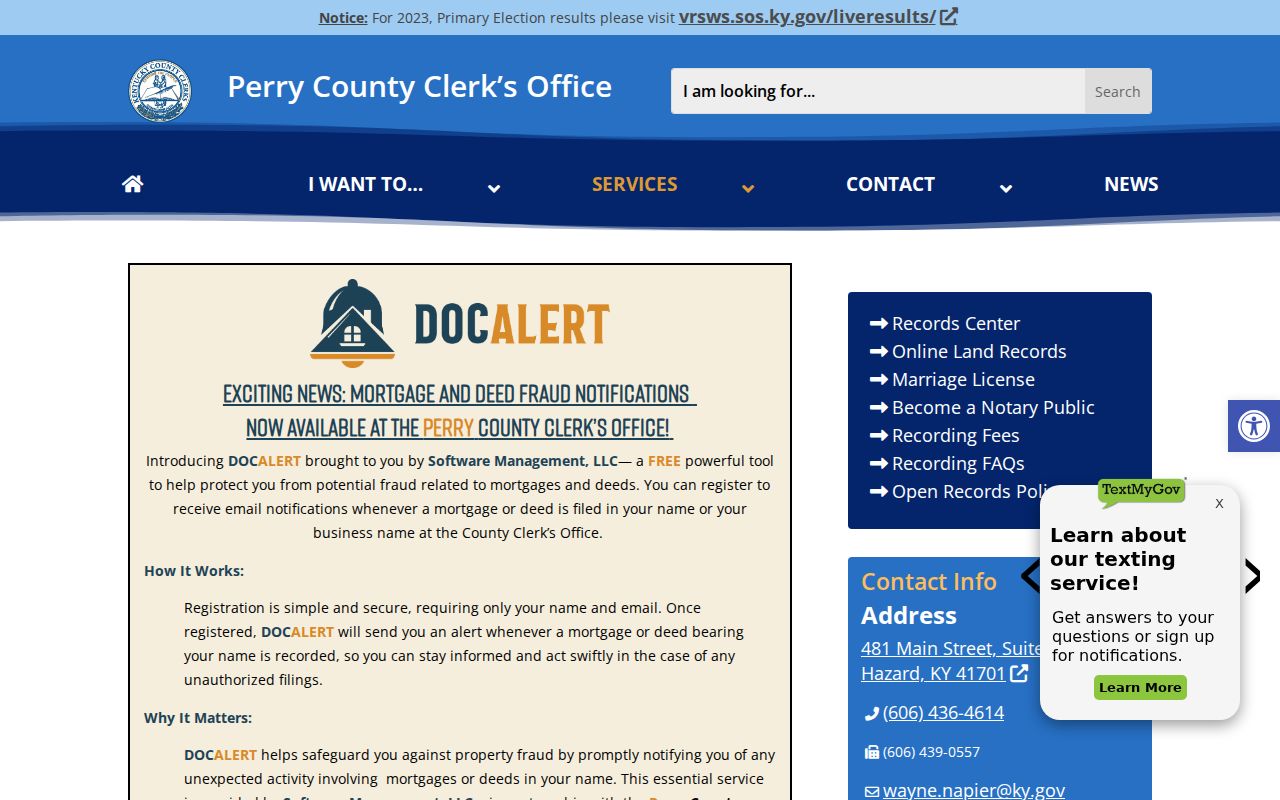
This page confirms the local route, not free vendor access.
What Perry County Search Results Show
An official state filing reproduces a Perry PVA parcel card. It is not live qPublic output. Still, the specimen carries a reliable inventory of fields. Those fields include APN 034-20-01-002.00, account 696509, class 10, and tax district 01. The location address reads CHAVIES. Description, lot, utilities, plat, zoning, flood, and data-upload details round out the card. The card also carries distinct Owner and Mailing lines.
| Owner | The assessment-roll name, separate from mail |
|---|---|
| Mailing | Where owner correspondence goes |
| Location Address | The situs or community label for the tract |
| APN and account | Two different record keys |
| Class and district | Assessment and taxing context |
| Description and plat | Clues for matching the recorded land |
A result is a snapshot, not a title report. Paid PVA features can add transfer history and photos. Improvement characteristics, property class, tax facts, and sales filters can appear there too. Verify exact live fields directly, since the public qPublic screen can restrict access. The official PVA search page marks the entry point for the Perry County property search.
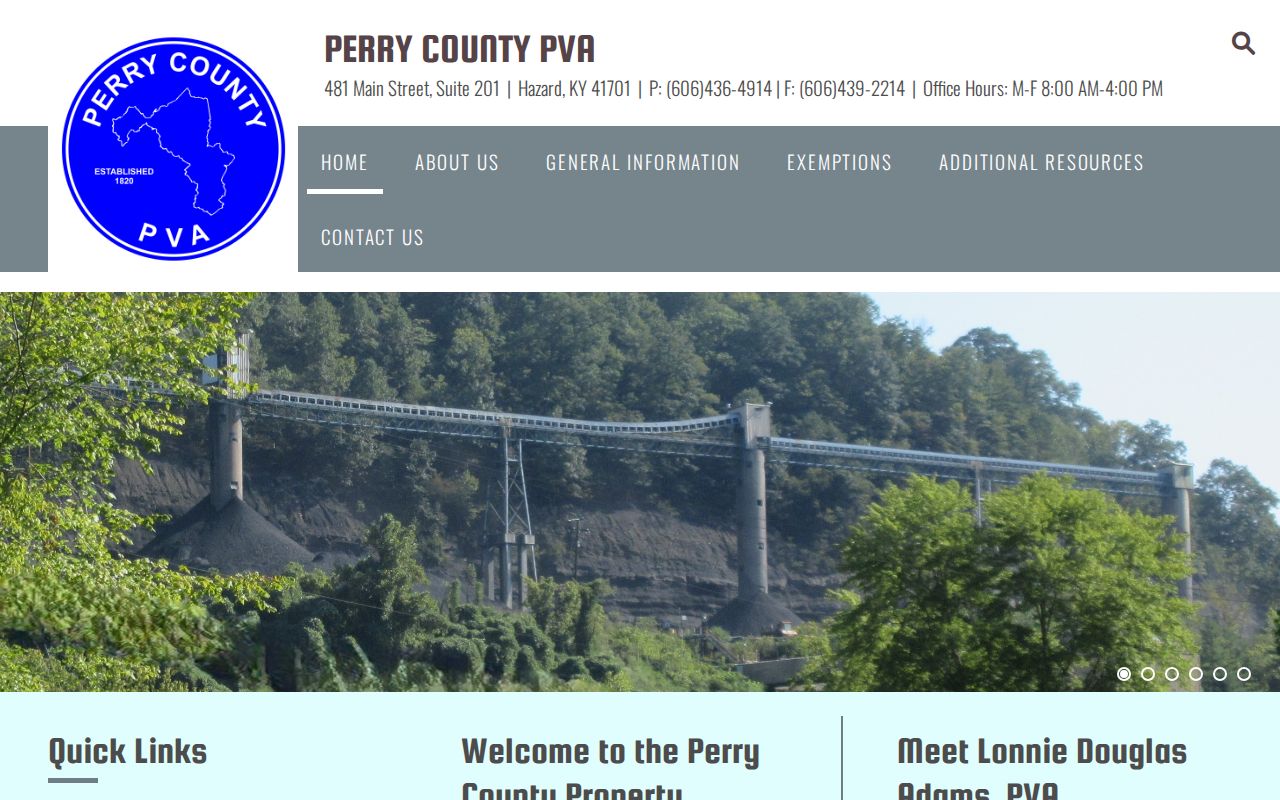
Use returned field labels as shown and save the date of the search.
Perry County Roll Update Gap
Perry County assessments are dated January 1. Buy a parcel in March and the PVA card may still list the seller as owner of record. It can stay that way until the next cycle. Depending on timing, the tax bill can carry the seller's name. It may instead show a "c/o" notation, or no name at all. That gap makes the recording date matter more than the tax roll.
For recent sales, set the PVA card beside the newest deed in eCCLIX. A freshly recorded deed is better proof of the current transfer. It beats a lagging tax roll. Confirm the parcel by legal description, though. A shared surname or a matching address can mislead on its own.
Fresh transfer check. Date both sources. If the deed was recorded after the roll date, ask the PVA when its Owner field is due to refresh.
Perry County Map Search Fallback
qPublic results sometimes include a View Map link. Perry County publishes no stand-alone GIS portal or open-data parcel map. No public street list or buffer tool exists. Do not substitute a similarly named Perry County system from another state.
Use the parcel view for neighboring APNs. Then open each PVA card one at a time. For a legal boundary, retrieve the deed and plat from the Clerk. Hire a licensed surveyor when stakes or disputed lines matter.
Note: A map polygon is a reference aid, not a legal survey or title finding.
Perry County Missing Record Requests
Missing online images or older index entries are no obstacle. Visit the Clerk counter or send a focused written request. The records counter is open Monday through Friday, 8 a.m. to 4 p.m. The online index reaches 1993. Images extend back to 2000. Older ledger records remain at the courthouse or archives.
A Kentucky resident may request records in writing under the Kentucky Open Records Act, naming the parcel or APN, record type, date range, known parties, book/page references, and preferred delivery. Agencies generally respond within five business days or give a written reason and expected time. Ask for existing records, not a title opinion.
Mailed real-estate records cost 25 cents per page. A $2 postage and handling charge applies per request. An older policy lists different rates, so confirm the live schedule before ordering.
Perry County Sales Search Filters
The PVA offers a subscription Sales Search. It adds filters beyond the free basic property search: sale price and date ranges, acreage, year built, sale type, neighborhood, and a qualified-sales limit. These tools help compare likely parcels. They can also test a reported transfer. The filtered list is not the recorded deed and cannot prove true comparability.
Save the search criteria with every result. Broad queries blend unrelated tracts. A range set too narrow may omit an older transfer. Open each parcel card. Compare land and improvement characteristics, and check the legal description. For an important sale, confirm the parties, date, consideration, and tract in the Clerk's recorded instrument.
The subscription layer may also show transfer history, photographs, property class, improvement details, and tax information. The PVA documents those fields, but confirm current labels and pricing before relying on the service.
Perry County Tax Search Handoff
A property search result identifies the assessed tract. Tax status follows a separate channel. The PVA determines value and does not collect tax. The Perry County Sheriff handles the current cycle at 120 N Hamilton Street in Hazard and may be reached at (606) 439-4523. The county publishes no interactive current-bill search, so the fallback is a call or office visit with the map ID and owner information.
Unpaid bills transfer to the County Clerk after April 15 of the following year. The Perry DTAX list then supplies Bill#, YearType, Owner Name, Property Address, Map ID, and Amount Due. It is a published list or PDF. It is not a current-bill query. A certificate purchased at the county sale can also lead to a recorded lien in the land records.
Keep the tax year beside any amount. Kentucky's collection calendar moves through discount, face-amount, and penalty periods before transfer. An older figure may not be the payoff. Local notice governs the sale date. Confirm the live total with the responsible office rather than treating a downloaded list as a final statement.
The record date also affects an owner search. A bill may stay in the former owner's name when a purchase occurred after the January 1 assessment date. Search the buyer and seller in the deed index. Compare the transfer date with the tax year. A c/o line is a mailing clue, not a substitute for the Owner field or the newest recorded deed.
For a distressed-property search, save the bill number, year/type code, map ID, list date, and amount shown. Then ask the Clerk whether a certificate, lien, release, or related instrument was recorded. The list reports one stage of collection. It alone does not prove the current balance or final ownership.
Compare Perry County Search Keys
No single key wins every Perry County property search. Address feels natural. It can fail on rural routes or changed street labels. Owner search casts wide but adds noise from entities and common names, while the APN pins one assessment parcel if its format and suffix are exact.
| Search Key | Best For | Where It Works | Watch Out |
|---|---|---|---|
| Address | Identify one tax parcel | PVA and map | Road, ZIP, and community variants |
| Owner name | Find parcels or recorded instruments | PVA and eCCLIX | LLCs, estates, trusts, same names |
| Parcel number | Reopen an exact assessment card | PVA and map | Account number is not the APN |
Not a title search. A Perry County property search reveals public records, but it does not guarantee clear title or expose every unrecorded claim. Obtain qualified title help for a legal ownership decision.
Use two keys. Pair owner with legal description, or address with APN. That combination beats any single field, and keeping the search date helps too, since assessment, deed, and tax systems update on different schedules.